
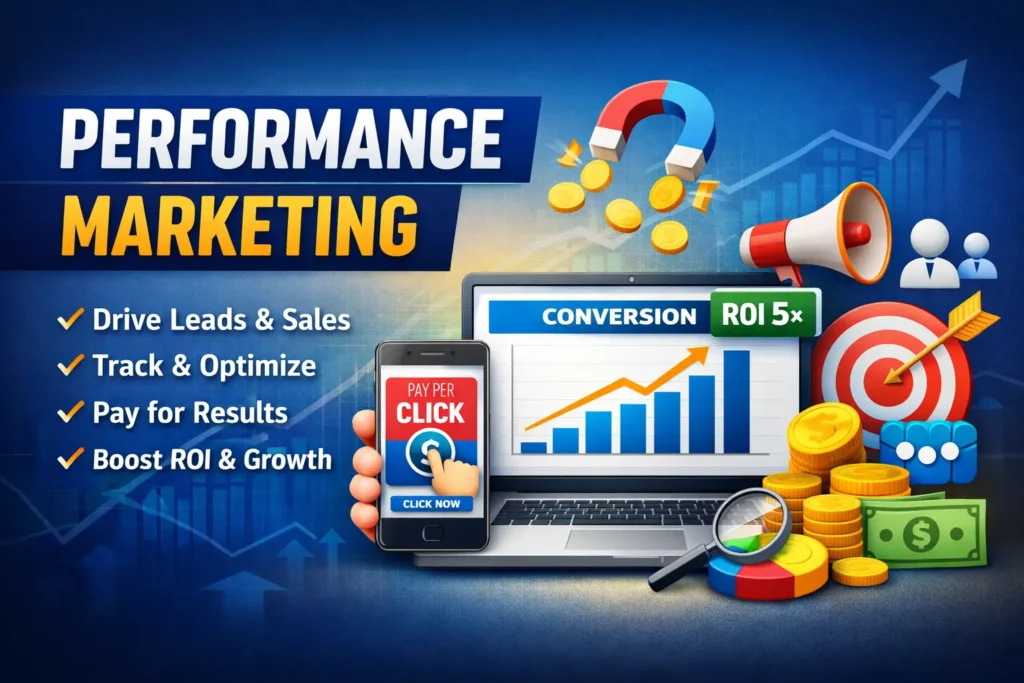
Performance Marketing: The Complete 2026 Guide to ROI, Strategy & Growth
Performance marketing is one of the most powerful ways to grow a business online because it focuses on real results. Instead of spending money on ads and hoping they work, performance marketing helps you track every click, lead, and sale. That means you can see exactly what you are paying for and what you are earning back.
In today’s digital world, businesses want marketing that is measurable, scalable, and profitable. That is why performance marketing has become a top strategy for brands, startups, and service-based companies.
In this guide, you will learn what performance marketing is, how it works, the best channels, important metrics, and practical tips to improve ROI.
What is Performance Marketing?
Performance marketing is a type of digital marketing where you pay for a specific action or performance. These actions can be:
- Clicks
- Leads (form submissions, calls, WhatsApp inquiries)
- Sales or purchases
- App installs
- Sign-ups
The best part is that everything is trackable. Because of this, performance marketing is often considered one of the most cost-effective marketing models.
Why Performance Marketing is Important in 2026
Performance marketing is growing faster than traditional advertising for one simple reason: it delivers measurable outcomes.
Here are the biggest reasons why performance marketing matters today:
1. You Can Track Every Result
With proper tracking, you can measure what is working and what is not. This makes decision-making easier and smarter.
2. Better ROI and Budget Control
You can start small, test ads, and increase budget only when you see results. Therefore, you waste less money.
3. Faster Business Growth
Performance campaigns can generate leads and sales quickly, especially when your offer is strong and your landing page is optimized.
4. Works for Almost Every Business
Performance marketing is useful for:
- Local businesses (gyms, clinics, salons)
- E-commerce brands
- Real estate companies
- Coaching and education businesses
- B2B service providers
How Performance Marketing Works (Step-by-Step)
Performance marketing is not just running ads. It is a full process that includes planning, execution, and optimization.
Step 1: Set Clear Goals
First, decide what you want:
- More leads
- More sales
- More website traffic
- More app installs
- More bookings or calls
A clear goal helps you create the right campaign structure.
Step 2: Choose the Right Platform
Different platforms work best for different goals:
- Google Ads → High-intent users searching for solutions
- Meta Ads (Facebook & Instagram) → Best for awareness + leads + retargeting
- YouTube Ads → Great for storytelling and trust building
- LinkedIn Ads → Best for B2B leads
- Affiliate Marketing → Performance-based partnerships
Step 3: Create High-Converting Ads
Your ads should have:
- A strong headline
- Clear benefits
- A clear CTA (Call Now, Book Free Call, Get Quote)
- Simple design and readable text
Step 4: Send Users to a Strong Landing Page
A landing page should be:
- Fast loading
- Mobile-friendly
- Simple and focused
- With one main CTA
- With trust elements like reviews, results, or guarantees
Step 5: Track Conversions Properly
Without tracking, you cannot improve performance.
Important tracking tools include:
- Google Analytics
- Google Tag Manager
- Meta Pixel
- Conversion API (optional but powerful)
- Call tracking (for service businesses)
Step 6: Optimize Regularly
Performance marketing is never “set and forget”.
You should regularly:
- Stop poor-performing ads
- Scale winning ads
- Test new creatives
- Improve landing pages
- Refine targeting and budgets
Top Performance Marketing Channels
Let’s explore the best channels used in performance marketing today.
1. Google Search Ads
Google Search Ads show your business when someone searches for keywords like:
- “best digital marketing agency near me”
- “performance marketing services”
- “google ads expert”
These users already have intent. As a result, conversion rates are usually higher.
Best for: Leads, sales, local services, B2B inquiries
2. Google Display Ads
Display ads show banners on websites and apps. They are cheaper than search ads, but intent is lower.
Best for: Awareness, retargeting, brand visibility
3. YouTube Ads
YouTube ads help build trust quickly using video. You can target by interests, keywords, channels, and remarketing.
Best for: Brand growth, product education, retargeting
4. Meta Ads (Facebook & Instagram)
Meta ads are powerful because you can target users based on:
- Age, location, gender
- Interests and behavior
- Lookalike audiences
- Website visitors and engagement
Meta is excellent for lead generation when your creative is strong.
Best for: Lead generation, e-commerce sales, retargeting
5. LinkedIn Ads
LinkedIn is best for B2B performance marketing. It is more expensive, but the quality of leads can be higher.
Best for: Corporate leads, B2B services, high-ticket offers
6. Affiliate & Influencer Performance Marketing
In this model, partners promote your product or service and earn commission per sale or lead.
Best for: E-commerce, apps, subscription products
Key Metrics in Performance Marketing (KPIs)
To get success in performance marketing, you must track the right KPIs.
1. CPC (Cost Per Click)
This is the cost you pay for each click.
Lower CPC is good, but only if clicks are quality.
2. CTR (Click Through Rate)
CTR tells how many people clicked after seeing your ad.
A higher CTR usually means your ad is relevant.
3. CPL (Cost Per Lead)
This is the cost of generating one lead.
Service businesses focus heavily on CPL.
4. CPA (Cost Per Acquisition)
CPA measures the cost of one final conversion like a sale or booking.
This is one of the most important metrics.
5. ROAS (Return on Ad Spend)
ROAS = Revenue / Ad Spend
Example: If you spend ₹10,000 and earn ₹50,000, your ROAS is 5X.
6. Conversion Rate
This tells what percentage of visitors take action.
Landing page improvements can boost conversion rate fast.
Performance Marketing vs Digital Marketing (What’s the Difference?)
Digital marketing is a broad term that includes:
- SEO
- Social media marketing
- Content marketing
- Branding
- Email marketing
- Paid ads
Performance marketing is more specific and focuses mainly on:
- Paid campaigns
- Trackable results
- Data-driven optimization
In simple words, performance marketing is a part of digital marketing, but it focuses only on measurable outcomes.
Performance Marketing Strategy for Better ROI
If you want consistent results, follow this proven strategy:
1. Start With a Strong Offer
Even the best ads cannot fix a weak offer.
Examples of strong offers:
- Free consultation
- Flat discount
- Limited-time deal
- Free audit report
- Buy 1 Get 1
2. Target the Right Audience
Good targeting saves money and improves results.
Use:
- Interest targeting
- Custom audiences
- Lookalike audiences
- Retargeting audiences
3. Use Multiple Creatives
Ad fatigue happens quickly. Therefore, you should create multiple versions:
- Different headlines
- Different designs
- Different videos
- Different angles (price, trust, results)
4. Retarget Warm Audiences
Retargeting is one of the highest ROI strategies.
You can retarget:
- Website visitors
- Instagram profile visitors
- People who watched your videos
- People who added to cart
5. Improve Landing Pages
Small changes can increase conversions:
- Strong headline
- Clear CTA button
- Trust badges
- Testimonials
- Fast loading speed
Common Mistakes in Performance Marketing
Many businesses waste money because of avoidable mistakes.
1. Running Ads Without Tracking
If you are not tracking leads or sales properly, you are guessing. That leads to loss.
2. Sending Traffic to a Weak Website
If your website is slow, confusing, or not mobile-friendly, conversions will drop.
3. No A/B Testing
Testing is necessary. Otherwise, you never know what works best.
4. Not Using Retargeting
Most people don’t convert on the first visit. Retargeting brings them back.
5. Focusing Only on Cheap Leads
Cheap leads are not always good leads. Focus on quality and conversion rate.
Best Practices to Improve Performance Marketing Results
If you want higher ROI, follow these best practices:
- Keep ad copy simple and benefit-focused
- Use strong CTAs like “Book Now” or “Get Quote”
- Use short forms for lead generation
- Use WhatsApp and call buttons for quick leads
- Optimize campaigns weekly, not monthly
- Track lead quality and sales, not just clicks
- Create fresh creatives every 10–15 days
Performance Marketing for Small Businesses
Small businesses can benefit a lot from performance marketing because it allows budget control.
A smart small business plan:
- Start with ₹300–₹1000 per day
- Run lead ads or search ads
- Track calls and form submissions
- Improve landing page
- Scale winning campaigns
With the right strategy, even small budgets can generate consistent leads.
Conclusion
Performance marketing is the fastest way to grow online when done correctly. It focuses on measurable outcomes like leads, sales, and conversions. With proper tracking, smart targeting, strong creatives, and continuous optimization, you can generate high ROI and scale your business confidently.
If you want to build a predictable system for growth, performance marketing should be a key part of your strategy in 2026.
FAQs
1. What is performance marketing in simple words?
Performance marketing is a type of marketing where you pay for results like clicks, leads, or sales.
2. Is performance marketing only paid ads?
Mostly yes. Performance marketing mainly includes paid campaigns that can be tracked and optimized.
3. Which platform is best for performance marketing?
Google Ads is best for high-intent searches, while Meta Ads are best for lead generation and retargeting.
4. What is the main goal of performance marketing?
The main goal is to generate measurable outcomes like leads, conversions, and sales with high ROI.
5. How do I measure performance marketing success?
You measure success using KPIs like CPL, CPA, ROAS, conversion rate, and revenue